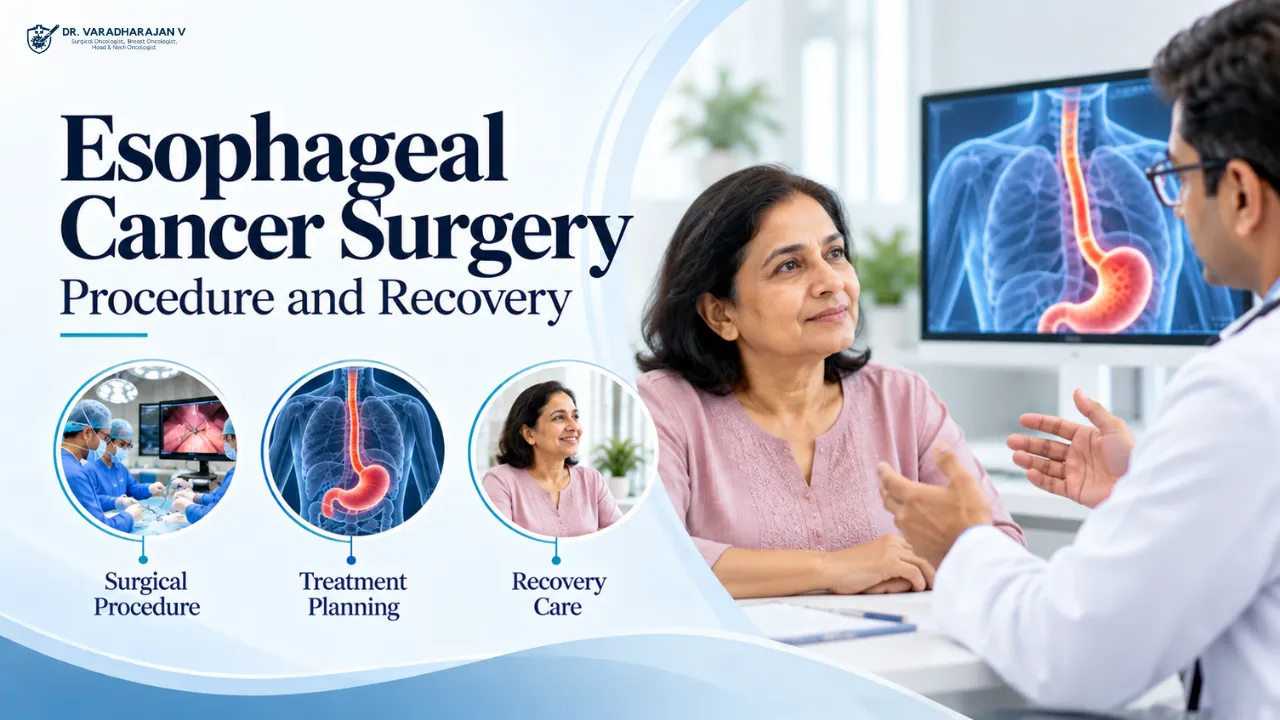
Esophageal cancer surgery, called an esophagectomy, removes the cancerous part of the food pipe (esophagus) and nearby lymph nodes. The surgeon then rebuilds the passage, usually by pulling up the stomach and joining it to the remaining esophagus. It is a major operation, often combined with chemotherapy or chemoradiation before surgery, and recovery takes several weeks to months.
Who May Need an Esophagectomy?
- Early or locally advanced esophageal cancer without distant spread
- Some cancers at the junction of the esophagus and stomach
- Patients who have completed chemotherapy or chemoradiation and are fit for surgery
Very early cancers may sometimes be treated with endoscopic removal instead.
How Is the Surgery Done?
Open esophagectomy
Uses incisions in the abdomen, chest and sometimes neck.
Minimally invasive esophagectomy
Uses small keyhole incisions with a camera. It may reduce pain and speed recovery in suitable patients.
Reconstruction
The stomach is shaped into a tube and joined to the remaining esophagus. A feeding tube may be placed into the small bowel to support nutrition early on.
What Happens After Surgery?
- ICU or high-dependency care for a short period
- Breathing exercises and early walking to prevent lung problems
- Drains and tubes removed gradually
- A swallow test before starting oral fluids
- Hospital stay of about one to two weeks
Possible Risks
- Leak at the join (anastomotic leak)
- Chest infection or pneumonia
- Irregular heartbeat
- Narrowing at the join, needing dilatation later
- Reflux and dumping symptoms
How Does Eating Change?
- Eat small meals five to six times a day
- Chew well and eat slowly
- Sit upright during and after meals
- Avoid lying flat soon after eating
- Raise the head of the bed to reduce reflux
- Work with a dietitian to prevent weight loss
When to Seek Help
Contact your surgical team for fever, chest pain, breathlessness, difficulty swallowing, vomiting or redness around wounds.
Key Takeaways
- Esophagectomy removes the cancerous food pipe section.
- The stomach is usually used to rebuild the passage.
- Chemotherapy or radiation often comes first.
- Recovery takes weeks to months.
- Small, frequent meals are needed afterward.
Final Thoughts
Esophageal cancer surgery is demanding, but careful planning and an experienced team make a real difference. Understanding each step helps you prepare. For assessment and surgical planning, you can consult Dr. Varadharajan, a surgical oncologist in Chennai.