
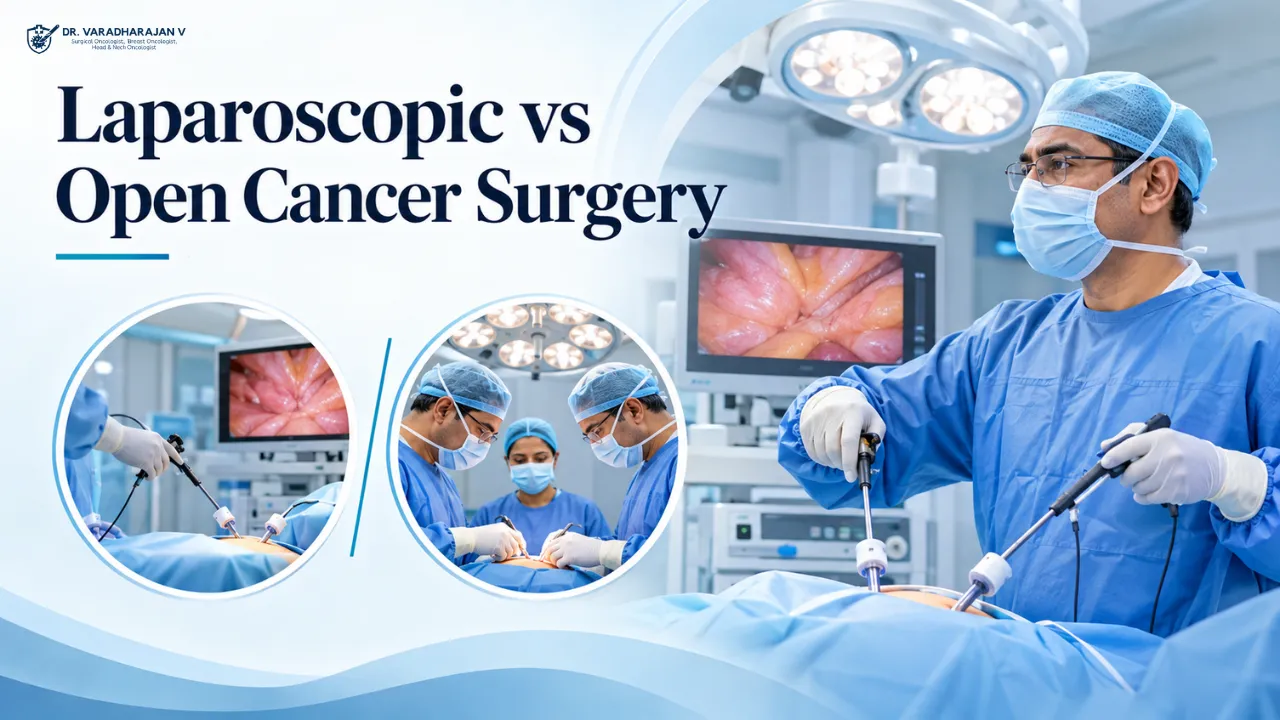
Laparoscopic (keyhole) cancer surgery uses several small incisions, a camera and fine instruments, while open surgery uses a single larger incision. For many cancers, laparoscopic surgery offers similar cancer outcomes with less pain, smaller scars and faster recovery. However, it is not suitable for every patient or tumour, and the safest choice depends on the cancer and the surgical team's expertise.
How Does Laparoscopic Surgery Work?
- Several small cuts, usually 0.5 to 1.5 cm
- A camera shows a magnified view on a screen
- Carbon dioxide gas gently inflates the abdomen for working space
- The tumour is removed through a small extraction incision
How Does Open Surgery Work?
- One larger incision gives direct access
- The surgeon can see and feel tissues directly
- Useful for complex or extensive procedures
Benefits of Laparoscopic Surgery
- Less post-operative pain
- Smaller scars
- Shorter hospital stay
- Faster return to eating and activity
- Lower risk of wound infection and hernia
- Less blood loss in many cases
When Open Surgery May Be Better
- Very large tumours
- Tumours involving major blood vessels or multiple organs
- Extensive adhesions from previous surgery
- Certain cancers where studies show better results with open surgery
- Emergency situations
Is Cancer Control the Same?
For many cancers, including colorectal, stomach, kidney and endometrial cancers, studies show laparoscopic surgery achieves similar cancer outcomes when done by experienced surgeons. For some cancers, such as early cervical cancer, evidence has favoured open surgery.
Conversion to Open Surgery
Sometimes a laparoscopic operation is converted to open surgery during the procedure for safety. This is a responsible decision, not a failure.
How Is the Approach Chosen?
- Cancer type and stage
- Tumour size and location
- Previous surgeries
- Patient health and body type
- Surgeon experience and available technology
Key Takeaways
- Laparoscopic surgery uses small incisions and a camera.
- It often offers faster, less painful recovery.
- Cancer outcomes are similar for many cancers.
- Open surgery suits some complex cases.
- Safety and cancer control guide the choice.
Final Thoughts
Both laparoscopic and open surgery have important roles in cancer care. The best approach is the one that removes the cancer safely and completely for your situation. For minimally invasive oncology assessment, you can consult Dr. Varadharajan, a surgical oncologist in Chennai.